Why Newt Boots is named for the rough-skinned newt, a Pacific Northwest native with an orange belly that walks out in the rain: natural history and metaphor.
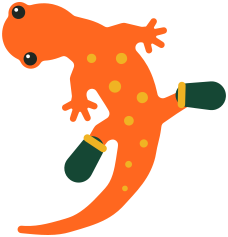
We named the company after the rough-skinned newt, Taricha granulosa, because it is the one animal in the Pacific Northwest that seems genuinely pleased when it rains. It is small, soft, slow and a little clumsy. It has a dark mossy back and a bright orange belly. And on the wettest days of the year, when everything else is hiding, it walks out into the open and goes somewhere. That was the whole brand in one creature. Your baby is a little newt. Rain is a reason to go out.
This post is the long version of that story: what the rough-skinned newt actually is, how it lives in our forests, and why it ended up on a pair of baby boots.
Meeting the newt
If you have walked a trail west of the Cascades on a wet day in fall or spring, you have probably stepped around one. Rough-skinned newts are four to eight inches long, brown to olive on top with skin that looks like damp sandpaper, and underneath they are a shade of orange that does not seem possible on an animal this understated. They range from Southeast Alaska down through British Columbia, Washington and Oregon into Northern California, mostly on the wet side of the mountains. Here in the Gorge they live in the mossy draws and creek bottoms on the western end, and we see them most on the trails around Hood River after the first real autumn rains.
They are the newt you are most likely to see in daylight. Most salamanders hide under logs and come out at night. Rough-skinned newts spend much of the year on land, and when it is raining they move around in the open, slowly, on the forest floor, often right down the middle of the trail. They do not seem to be in a hurry and they do not seem worried about you.
Why it can afford to be slow
The newt's calm has a reason. Rough-skinned newts carry tetrodotoxin in their skin, the same potent neurotoxin found in pufferfish, and they carry a lot of it. It is one of the most toxic animals in North America. Nothing eats it except a few populations of common garter snakes that have evolved resistance, and the snakes and newts have been in an evolutionary arms race for a very long time, each getting a little more toxic or a little more resistant in step with the other.
Because almost nothing can eat it, the newt has no need to run, hide or be nocturnal. It can walk across a trail at noon in the rain. When it does feel threatened it does something called the unken reflex: it arches its back, lifts its head and tail, and shows off the orange underside. The orange is a warning label. It says, in effect, do not bother.
A practical note for parents: this means you should not let a child handle a newt, and you should wash hands if anyone does. The toxin is only dangerous if it gets into the mouth, and healthy skin is a fine barrier, but toddlers put hands in mouths constantly. Look, do not touch, and move it off the trail with a stick if it is about to be stepped on.
For amphibious babies.
Waterproof crawling booties, $39.99. Two sizes, five colorways. Preorders open.
A life timed to the rain
Rough-skinned newts spend the drier months on land, under logs and in burrows, and they come out when the ground gets wet. In fall and winter rain they are active on the surface. In late winter and spring, adults migrate to ponds, lakes and slow stream pools to breed, sometimes walking surprising distances to the same water year after year. The males change shape for the breeding season, growing smoother skin and a flattened tail for swimming. Eggs are laid singly on underwater plants, and the larvae spend their first season in the water with feathery gills before they come out onto land.
In other words, the newt's whole calendar runs on wet weather. The rain is not an interruption to its life. It is the schedule.
That is what we kept coming back to when we were naming the company. Our first winter with a baby, we treated rain as the thing that cancelled plans. Walk cancelled, park cancelled, trail cancelled. We stayed in more than we wanted to, and by February the whole family was climbing the walls. The next fall we decided the rain was the schedule instead, and the only thing standing between us and the trail was a baby with wet socks.
Why the belly is orange
The orange belly solved a design problem for us as much as a naming one. We wanted the booties to feel like the forest: moss, bark, wet stone, the colors of a Gorge trail in November. But a bootie that is all moss is one you lose in the stroller basket and never find on the trail when it comes off. We needed a flash of something bright.
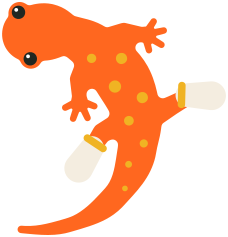
The newt gave us the answer. Fir green on the outside, a shot of orange underneath that shows when the baby is crawling. Every pair of Newt Boots has a Newt Orange sole, and the orange is our accent color across everything. It comes directly from a newt turned on its back in a puddle. We did not have to invent a palette. The forest already had one.
Soft skin, wet world
There is a second reason the newt fit. It is soft. It has no shell, no scales, no armor. Its skin is permeable, which is why it needs the moisture, and it moves with a slow, deliberate, slightly wobbly gait that any parent of a crawling baby will recognize immediately.
Babies in the age window we build for, roughly six to eighteen months, are crawlers. They are not ready for hard boots, and most of them are not walking. Their feet are soft, still mostly cartilage, and they spend their outdoor time on hands and knees. Stiff rubber boots at this age slide off, feel like weights, and get in the way. What we wanted was something that acted more like skin: waterproof, made for crawling, and worn over a rain suit so the whole baby stays dry on a wet trail. The newt was the model. We wrote about the development side of this in why soft, flexible soles matter, and how the booties go on in how they work.
What we are not claiming
We like the newt metaphor a lot, so we want to be clear about where it ends. Newt Boots are booties. They are waterproof, they are made for crawling, and they go on over a rain suit. They do not make your child healthier, more resilient, or better at anything. The newt is a mascot and a reminder, not a health claim. What we do believe, and what research on outdoor play broadly supports, is that time outside is good for kids and good for the adults with them, and that the hardest part of getting outside in winter is usually logistics. We make one piece of the logistics easier. The rest is on you, and you can do it.
If you want the research side, we collected what we could stand behind in benefits of outdoor play for babies.
How to find a newt with your kid
Looking for newts is a good rainy-walk game for a toddler, and it costs nothing.
- Go on a wet day in October, November, March or April, west of the Cascades. Mid-morning after overnight rain is good.
- Pick a forested trail with a creek or pond nearby. Tryon Creek in Portland, the Lower Macleay Trail, and the wet draws around Hood River all have them.
- Walk slowly and watch the trail itself, not the woods. Newts walk down the middle of the path.
- Look for a brown lump that moves. Then crouch and look for the orange underneath.
- Do not touch. Wash hands after the walk regardless, because toddlers.
A kid who has watched a newt cross a trail in the rain has learned something about the forest that does not come from a book, and a parent who has crouched in the mud to watch it has, in our experience, stopped minding the mud. That is what we are after.
The short version
We named the booties after an animal that is soft, slow, bright underneath, and completely at home in the rain. We want babies to be able to be the same. Little newts get outside. For amphibious babies. If you want to see what came of it, the booties are in the shop, and the rest of the story is on how they work.
FAQ
What is a rough-skinned newt?
Taricha granulosa is a salamander native to the Pacific Northwest, from Alaska to Northern California, with grainy brown skin and a bright orange belly. It is active on land in wet weather and breeds in ponds.
Are rough-skinned newts dangerous to kids?
Their skin contains tetrodotoxin, which is dangerous if swallowed. Handling with intact skin is generally not harmful, but children should not touch them, and everyone should wash hands after a walk.
Why is the newt's belly orange?
The orange is a warning color. When threatened, the newt arches to show it, signaling to predators that it is toxic.
Where can I see a rough-skinned newt?
Forested trails west of the Cascades on rainy days in fall and spring, especially near creeks and ponds. They often walk right down the middle of the trail.
Does the newt mascot mean the boots are good for development?
No. The newt is a mascot and a reminder to go out in the rain. Newt Boots are waterproof crawling booties worn over a rain suit; we do not make health or development claims.